Carpenter vs joiner: what's the difference?
"Carpenter" and "joiner" are often used interchangeably in everyday conversation, and in modern UK practice many tradespeople genuinely do both jobs. But the terms do have a traditional distinction worth understanding, partly because it helps explain why some tradespeople describe themselves one way rather than the other, and partly because it can be a useful clue about what kind of work someone specialises in.
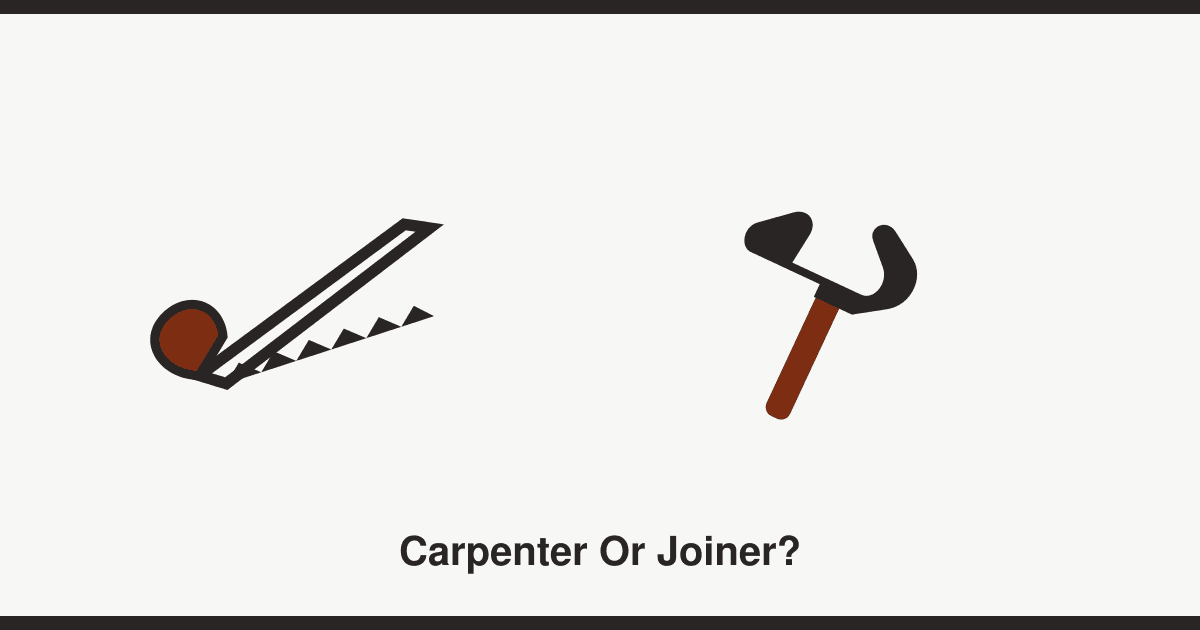
The traditional distinction is really about where the work happens and how it's made. A joiner traditionally works in a workshop, constructing items from timber — historically this meant joining pieces of wood together using techniques like mortise-and-tenon or dovetail joints, without relying on metal fasteners such as screws or nails, though modern joinery uses a mix of traditional joints and mechanical fixings depending on the item. A carpenter, by contrast, traditionally works on-site, fitting, installing and repairing timber structures and items directly in a building — often using more portable tools and typically fixing things with screws and nails rather than crafting complex joints from scratch.
In practical terms, joinery tends to cover things like bespoke staircases, period-style windows, ornate skirting or architrave profiles, fitted cabinetry, and custom furniture — items that are largely made to measure in a workshop, using heavier, mains-powered machinery such as table saws and planers, before being delivered to site ready to install. Carpentry tends to cover on-site work such as fitting doors, building stud partition walls, laying timber flooring, constructing roof structures, and installing skirting or architrave that's already been manufactured elsewhere — work that generally uses lighter, portable tools suited to being carried from job to job.
There's also a genuine regional pattern in how the words are used across the UK, separate from the technical distinction. In the south of England, "carpenter" tends to be the more commonly used term for a general timber tradesperson, covering a broad range of site-based work. In the north of England, "joiner" is often the preferred term, even for work that would technically be described as carpentry elsewhere — so a "joiner" advertising their services in Leeds or Newcastle may well be doing largely the same site-based work as a "carpenter" would in London or Bristol. This is worth bearing in mind when you're searching a directory or asking around locally, since the word someone uses to describe themselves doesn't always map neatly onto the traditional workshop-versus-site distinction.
In reality, most tradespeople trained today hold a combined qualification, typically covering both carpentry and joinery skills as a single trade, and many run businesses that take on both workshop-made items and on-site fitting work as needed. A typical UK apprenticeship or college course leading to a City & Guilds or NVQ qualification is usually titled "Carpentry and Joinery" precisely because the two skill sets are taught together rather than as entirely separate trades, and it's common for someone to specialise more heavily in one side of the work as their career develops, without losing the grounding in the other. Larger firms sometimes do separate the two roles more formally, with dedicated bench joiners producing items in a workshop that site carpenters then install, particularly on bigger commercial or new-build projects — but for most home improvement jobs, you're likely to be dealing with one person or small team who covers the whole process, from initial design through to final on-site fitting.
So which do you actually need? For fitting doors, skirting, architrave, flooring, stud walls, or general repairs and installations around the home, a carpenter — or a joiner who also does site work, which is most of them — is exactly what you're looking for. For something more bespoke that needs to be built from scratch to an unusual size or design, such as a fitted bookcase with intricate detailing, a period-accurate staircase, or made-to-measure sash windows, it's worth specifically asking whether the tradesperson does their own workshop joinery, or whether they subcontract that part of the job to a specialist joiner before fitting it themselves. Either way, the most useful question to ask isn't "are you a carpenter or a joiner?" but simply "have you done this specific type of work before, and can I see examples?" — since the practical skills involved matter far more than the job title on the van.
Frequently asked questions
Not necessarily — they represent traditionally different, complementary skill sets rather than a hierarchy. Joinery traditionally emphasises precise workshop-made joints, while carpentry emphasises accurate on-site fitting and installation. Many tradespeople are proficient in both.
It reflects a regional naming convention rather than a difference in the work itself. "Joiner" is the more commonly used term in northern England for a general timber tradesperson, while "carpenter" is more common in the south, even when the actual work overlaps heavily.
Often yes, or a carpenter who either does their own workshop joinery or works with one — bespoke, made-to-measure items are traditionally a joiner's specialism. It's worth asking directly whether they make items in a workshop or focus on site-based fitting.
Yes — most carpentry and joinery training in the UK today combines both skill sets, and many tradespeople comfortably handle both bespoke workshop-made items and on-site fitting, particularly for typical home improvement projects.